

Customer portals and self-service portals for businesses
Customer portals and self-service portals open up new opportunities: your customers can take care of their business when it suits them, and your organisation can focus on what matters most. We help you build a customer portal solution that serves both.






Smooth and effortless transactions regardless of time or place
Customers expect smooth and hassle-free service regardless of time or place. Customer portals and self-service portals enable a centralised, secure and efficient way of conducting business online without unnecessary manual work, intermediaries or fragmented systems.
At Sofokus, we implement customer portals and self-service portals that support our customers’ business operations, automate processes and improve the customer experience. We always design portal solutions based on customer needs and integrate them seamlessly into the organisation’s existing systems, such as ERP, CRM, PIM and DMS.
The project proceeded as planned, with smooth and open communication. Promises were kept, and the budget remained under control. We are very satisfied.


What is a customer portal?
A customer portal is a web-based service that allows customers, members or stakeholders to conduct their business independently and securely. Customer portals are often referred to as self-service portals due to their self-service capabilities.
Modern customer portals typically include strong authentication, multi-level user management, various forms, document delivery and management features, and, for example, order history and statuses. Through a customer portal, customers can order additional services, make purchases, and communicate with the organisation through the same user interface. Integrations with often complex back-end systems ensure that information flows seamlessly between different systems.
A well-designed customer portal brings all services together in one place and makes transactions clear for both the user and the organisation. This consistency is particularly important in a B2B environment, where customer relationships are long-term and transaction needs are diverse.

How does a customer portal benefit customers and the company?
A customer portal and self-service portal benefit both parties in concrete and measurable ways. From the customer’s point of view, the biggest change is freedom: self-service portal services are available 24/7 and matters can be dealt with at one’s own pace without queuing or waiting for phone calls. Customers get a clear view of their own information and pending matters through the customer portal, which reduces the need to contact customer service. This significantly improves the overall customer experience.
For organisations, customer portal benefits are directly visible in resource utilisation and efficiency. When routine matters are transferred to a self-service portal, the customer service workload is reduced and staff can focus on more demanding tasks. Processes become faster and more automated as manual processing is reduced. The quality and manageability of data improve significantly when data is entered directly into the customer portal system without any intermediate steps. At the same time, reporting and traceability improve, and the transparency of customer communications increases. Information security and data protection are better controlled when everything takes place in a single, controlled customer portal environment.
A customer portal is therefore not just an online service, but a key part of a functional and scalable service process that supports the development of the entire organisation.

Customer portal integrations and information security
We implement customer portals and self-service portals for various purposes and operating environments. Customer portals serve both B2B and B2C customers in the management of orders, agreements, documents and services. Public sector portals place particular emphasis on accessibility, information security and legislative requirements when providing services to citizens or businesses. Member and partner portals, on the other hand, serve the needs of member organisations, associations and partner networks with their own special features. Internal self-service portals for staff and stakeholders are also an important part of the digital service experience.
We always design our customer portal solutions based on the actual needs and processes of our customers. We do not offer ready-made packages, but tailor each customer portal implementation to the specific requirements of your organisation.
Working with Sofokus has been smooth and efficient. Meetings have been well prepared, and we have always been given clear estimates of the time required before the next development phase. This has been particularly important for a small organisation.

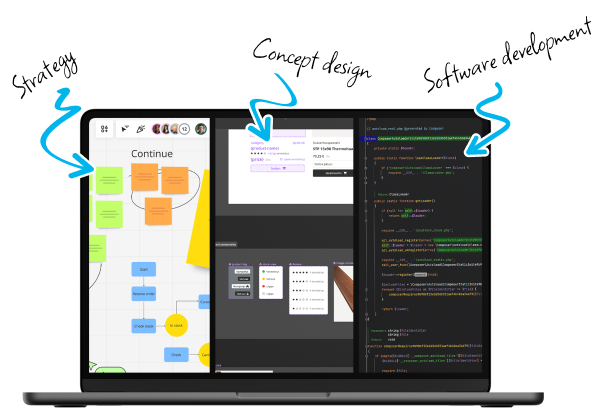
This is how a customer portal project usually progresses
- Mapping needs and processes
We understand what we are solving and for whom.
- User paths and design
We design the structure and user experience of the service.
- User interface design
We design the user interface of the service with accessibility and other requirements in mind.
- Technical implementation and integrations
We build solutions on a sustainable and maintainable foundation.
- Testing and implementation
We ensure functionality and data security before release. - Further development and support
The service channel will evolve in line with needs.
Frequently asked questions
A typical project costs between €50,000 and €200,000, depending on its scope and integrations. The smallest implementations start at around €30,000, while large B2B portals with multiple integrations often require larger investments. A more accurate estimate will be provided during the specification phase.
The simplest customer portal can be completed in a few months. Medium-sized projects with integrations are up and running in 3–6 months. Larger projects or railways with multiple complex integrations take 6–12 months. We will draw up a more detailed schedule together during the specification phase.
Yes, and we often recommend this approach. Start with the most important features and add functionalities based on customer feedback. We build a foundation that flexes with your business so you don’t have to rebuild when your needs grow later on.
You own all code and intellectual property rights. We build using standard technologies and document everything carefully. If you want to change partners or take maintenance into your own hands, that’s fine. In practice, however, our customers almost always stay with our maintenance services because further development and maintenance are so easy for us.
We conduct user research and test prototypes with real users before the actual implementation. A user interface designer is always involved to ensure that the portal is intuitive for both your customers and your staff. We don’t just build something that works technically, we build something that is truly usable.
We need a contact person who understands the processes and is able to make decisions. Software development expertise is not required, as we take care of the technical implementation entirely. If you have an IT department, we are happy to work closely with them on integration and security issues.
We offer continuous maintenance and support flexibly according to your needs. We can handle just technical maintenance or be more actively involved in further development.
Yes. We also have experience with integrations into older systems that do not have modern APIs. If necessary, we will build an intermediate layer or use other techniques to transfer data securely. Tell us about your system and we will assess the possibilities.