


Boco IP
AI Opportunity Assessment elevated AI adoption from tool level to system level
Boco IP is a Finnish intellectual property firm with nearly 100 years of experience, providing services for managing patents, trademarks, and other intellectual property rights. The company’s experts had already gained experience with individual AI tools, but significant business benefits had yet to materialise. We conducted an AI Opportunity Assessment for Boco IP, resulting in a clear vision and roadmap for integrating AI into both daily work automation and long-term strategic coordination.
“We achieved a lot in a short period of time.”
A familiar starting point for many professional services organisations
Boco IP’s situation before the assessment project will likely resonate with many professional services organisations. The impact of AI on the industry had been recognised, and the company was already exploring how AI is transforming expert work and opening new business opportunities. They had gained experience with language model-based tools like Microsoft Copilot, but their use was primarily focused on supporting individual tasks.
In daily work, AI brought isolated benefits, but it hadn’t yet transformed the bigger picture. AI tools functioned only as task-level assistants and weren’t integrated into processes, decision-making, or strategy. Many experts also felt frustrated: how to prevent language models from hallucinating facts, how to ensure results reflect reality, and how to achieve the desired benefits in practice?
The assessment project’s goal became clear: elevate AI from the task level to the operating system level and build a shared understanding of where it provides genuine value and how it can transform Boco IP’s entire value chain — not just individual tasks.
What was done during the mapping of AI opportunities?
- Multiple workshops were held covering topics such as Boco IP’s current and target state of AI adoption, workflows and processes across different roles, and strategic opportunities
- A company-wide survey was conducted on AI competence levels, attitudes, and expectations
- The workshops and survey produced a unified vision: AI should be tightly integrated into the organisation’s processes, both as automation in daily work and as support for long-term coordination and ecosystems
- A set of use cases was identified, and a model was defined for prioritising them based on impact, feasibility, and alignment with business objectives
- Based on these findings, a roadmap, system-level technical requirements specification, and preliminary risk management plan were developed
Key insight: AI delivers the most value beyond individual task execution
During the AI Opportunity Assessment, the Boco IP team also deepened their understanding of what artificial intelligence actually is and what it can do at its best. They realised that AI is not most effective when it simply mimics how humans perform individual tasks — such as drafting patent applications the same way they’ve always been done. Its true potential emerges when it’s used to build a system that transforms an entire system, process, or value chain. For example, AI can integrate different application, agency, and customer data streams and coordinate expert collaboration from start to finish in advancing patent applications.
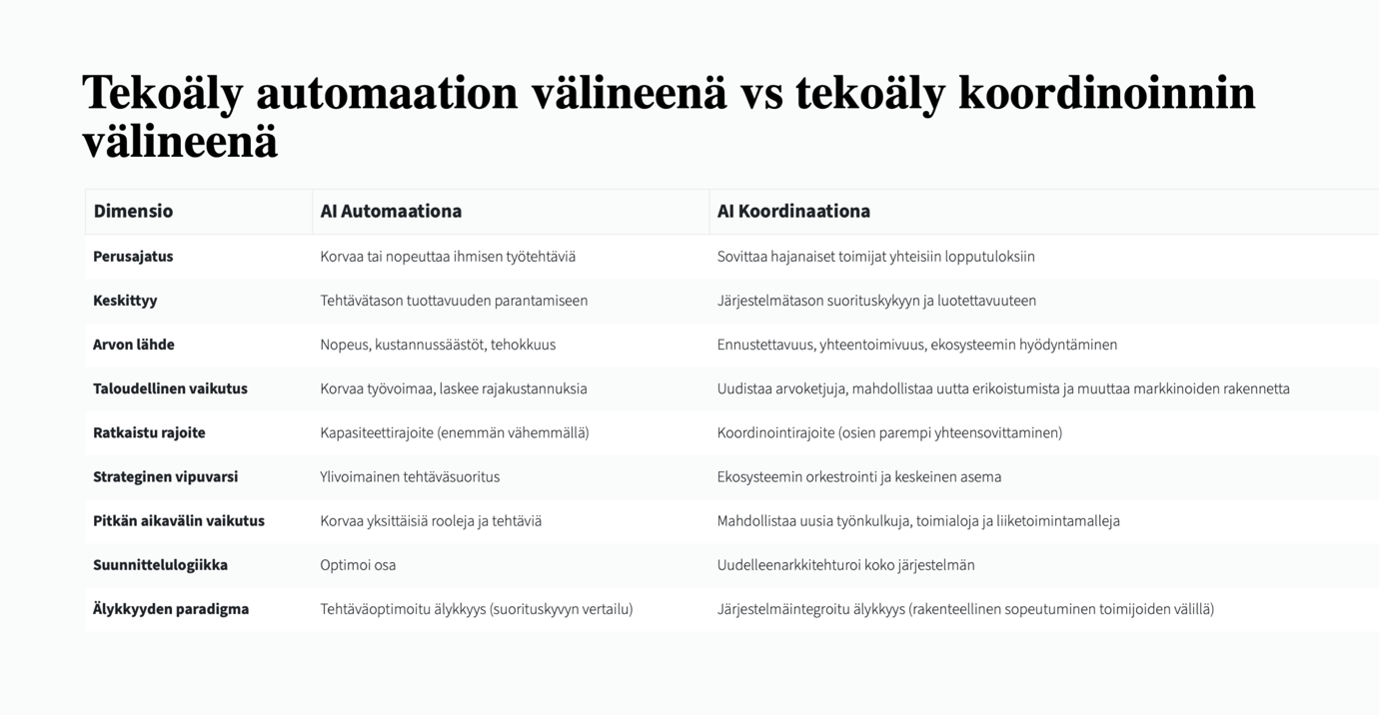
AI can support these kinds of comprehensive systems at both the automation and coordination levels. Automation brings speed and cost savings at the task level, while coordination creates a broader system that connects people, processes, and data—forming a new kind of competitive advantage.
The table illustrates this shift: at the automation level, AI optimises individual components, while at the coordination level, it transforms the operating logic of the entire system.

The outcome: shared direction, clear development steps, and a new competitive advantage
The assessment project gave Boco IP a comprehensive view of where AI can effectively benefit the company’s operations. Based on the workshops and survey, concrete use cases were identified where investment is justified from a business perspective, as well as areas where AI integration isn’t yet appropriate.
The team now has a clear plan for gradually integrating AI into business operations. The first development areas have been defined, focusing on both everyday automation and longer-term coordination — how information, processes, and expert work interconnect.
At the same time, Boco IP’s understanding of AI’s role deepened. AI is no longer viewed solely through the lens of individual tasks, but as a tool that can also transform what happens around the task: how to organise, lead, and create value.
“We reached our goal, and the workshops were successful. People got to share their thoughts, and even though there had been previous disappointments, participation was enthusiastic. We got lots of ideas and identified things that were important both strategically and concretely.”

Considering leveraging AI to develop your business, but unsure how to proceed?
An AI Opportunity Assessment gives your organisation a clear starting point for leveraging artificial intelligence. The assessment process, conducted with our digital business consultants, helps identify the business areas where AI can generate the most significant value. At the same time, you’ll set clear goals for AI initiatives aligned with your strategy and build a solid foundation for smoothly implementing AI solutions in your daily operations.

Would you also like to explore the potential of AI in your organisation?
Get in touch, and we’ll talk more!